Ad Fatigue and my Hierarchy of Needs

I am officially retired after over 46 years of gainful employment. This new life stage is a chance to count the blessings, reorient myself, focus on new goals and the road ahead. To gradually ease into the big change I started weeding out my digital presence and social media networks. If you happen to be one of the people who got “deleted”, don’t take it personally. It’s not that I don’t “like” you anymore – it just means that I don’t think our interactions would be deep and meaningful in the future.

When you spend time on social media, clicking on names of people or pages, after a while the algorithm starts showing you different ads. It thinks your interests have changed. When I noticed the change I realized that I don’t pay attention to ads anymore. We are all being bombarded with ads for products and services online, offline, in magazines and papers, on TV and radio channels, in our news feeds and social media accounts. The average person “sees” between four and seven thousand ads per day. Or, actually, we don’t see them. The phenomenon is called “ad fatigue”.

There are entire industries researching why ad fatigue happens, how to prevent it, and how to measure success in advertising. I personally don’t need to advertise anything – my life doesn’t depend on making money by selling myself, or my products, or my ideas. I wish, though, that advertisers – or their products and services – would consider my needs better, offering the things that I often search for and have no luck finding in the endless flood of useless ads.
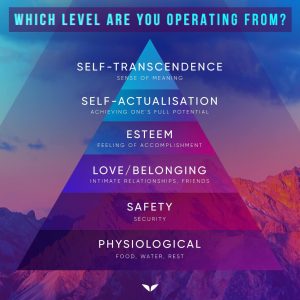
Maslow's hierarchy of needsSo, what is it, that I need/want and would actually buy at this point in my life? Abraham Maslow had a pretty good grip on what motivates people. He discovered a hierarchy of human needs and depicted that as a pyramid with initially five steps. He later realized there was something motivating the people at the top of his pyramid to even higher levels of achievement and postulated a sixth step. I agree, the top is definitely there – transcendence is the pinnacle.

I am old enough to have worked my way up the pyramid to the fifth level. I have food, water, clothes, a house, a social life, friends and family, I reached (almost) my full potential. I am actively pursuing level six now. I frequently dig through the internet, searching for something that I’d spend real money on – and can’t seem to find. So why can’t Google, or Amazon, or any search engine, deliver the results that I am searching for? Simple: advertisers don’t realize that there is this untapped target group of potential customers at the top of the pyramid.

I don’t “need” shoes (something from level 1 or 2 of the pyramid) for example, but I do buy shoes often. I like shoes. Very specific shoes. It took me years to find a manufacturer or two who make “my” kind of shoes. So, if you are selling shoes, you’d have to pay close attention to what I am searching for (mostly attributes from level 5 and 6 of the pyramid) and then target your ads to deliver on those search terms – unless you really don’t want me to buy your shoes.

When I am looking to buy new shoes, here’s what I would typically search for: “wide shoes handmade in Europe out of genuine leather with flat heal and round toe box”. Now, if you’d offer my size, favourite colour, easy return policy, and payment via Klarna – we’re in business. Even if your shoes are “expensive”. Or, maybe, especially if your shoes are “expensive”.

I know, I’ve become a snob.

Joint Venture 2.0

After over 46 years of working in I.T. as a programmer/analyst it was high time for me to retire. I admit I feel accomplished and exhausted at the same time. The one word that describes my state of affairs would be “enough”. Financially, mentally, and most of all physically, I’ve had enough of it.

About two months ago I went to see an orthopedic doctor just to have him confirm what I sort of guessed already – because I’ve been there before, in 2016. Joint Venture, first edition
For the last two or three years my left hip had been bothering me more and more. It had gotten to the point were I was in pain day and night, couldn’t walk the stairs in our house without dragging my left leg behind, was unable to run if my life depended on it.

severe osteoarthritis left hip The x-ray image of my left hip looked worse than what I remembered from the right side eight years ago. The doctor’s diagnosis sounded like a “death sentence”.

He said in a calm, professional, emotionless voice: “well, as you can see here you have advanced degenerative osteoarthritis, stage four. Bone on bone, almost no cartilage left as far as I can see. You are an excellent candidate for total hip replacement surgery. I’d like to introduce you to a colleague of mine.”

No way! Germany holds the world record in hip replacement surgeries per capita. Statistically 75% of those are performed unnecessarily, or at least prematurely. On top of that 23% of those people come back with the same, or worse, symptoms after just one year. So I said: “no, thanks.” The doctor then suggested different types of injections, and prescription pain medication. My response to that was: “not a good plan either.” At that point the doctor’s face briefly slipped out of the professional pose when he asked “so, what do you expect from me?”

I told him that I was hoping for some advice about what I could do personally to improve my condition. He didn’t have a whole lot to say there, but prescribed six sessions of physical therapy. So I dug out my old notes, and brushed up on my knowledge about bones and cartilage and joints and general self-care. The physical therapy actually helps too, so I’m going to continue that.

On my way out I got one piece of good news from the doctor, though. I had asked, in the light of the terrible condition of my left hip, what was his prognosis for my right side. I had not told him about my adventure there in 2016. Pointing at the fresh x-ray the doctor said: “no, your right side is perfectly fine, no hint of a problem there.”

If you’re having similar ailments, you could go back to my old article. Everything I said there still works:
Fight inflammation first, then build new cartilage. Eat clean, avoid animal sourced food. Don’t drink alcohol, don’t smoke, don’t take drugs. Get enough sleep, hydrate well, exercise daily, keep your weight low and your spirits high.

I had to revise my supplements list, though, adjusting for what’s available in Germany. As always, do your own research, and be advised that I am not a doctor.

General micronutrients one tablespoon daily with breakfast
LaVita

Glucosamine complex take 3 capsules daily, with food
Glukosamine, chondroitin, MSM, and more

Elemental silica two capsules daily
Silizium-3-Komplex

UC-II collagen take one capsule at night, before going to bed
UC-II collagen

Celadrin three capsules daily with water
Celadrin

On top of these essentials, I add several other supplements to my diet that may help with osteoarthritis too.
grass-fed bovine collagen
Fish oil Omega-3
Rosehip powder
L-Lysine

The real reason why YOU shouldn’t buy an EV now

Late last year my husband and I bought a new battery electric car. Our beautiful Tesla Model Y, sporting the stunning midnight-cherry-red color only available in Europe, is one of 45,818 sold in Germany that year. Designed in California, manufactured in Grünheide, Germany, the best car (in my opinion) that one could buy in 2023. In fact a lot of people must have thought the same. The Tesla Model Y ended up being the one car – regardless of engine type – that was sold the most worldwide in 2023. 1,211,601 units of it, to be precise.

Friends, neighbors, colleagues, everybody asked: how do you like it? At first I was so excited about telling everybody what an awesome car that is. I even went to great lengths to debunk all the myths around EVs. I got frustrated when I realized,  that nobody wanted to hear my answers. People just wanted their prejudice confirmed. If you are one of the smart lucky ones who already own an electric car, preferably a Tesla, you’ve probably heard all the reasons, why EV isn’t a good choice.

One of our neighbors doesn’t want an electric vehicle, because his gasoline guzzling Audi can drive 300 km/h, and our Tesla only does 230 km/h max. I wonder where in Germany he finds a stretch of road that supports those 300 km/h.

Many people say they can go 1,000 km without refueling, while our extended range Tesla only gives us 450 km, on a full charge. I wonder why anybody would want to drive 1,000 km without having a break. Even 450 km is too long for me. I need a break every two hours or so, just to go to the bathroom and stretch my legs.

Somebody said he can refuel his car in 5 minutes, while our Tesla takes about half an hour at the super-charger to go from 30% to 90% charge. I highly doubt the statement – 5 minutes? Really? Even if the nearest pump is free, you’d have to open the tank, insert the nozzle, stand there and wait for your 40 l to run through, walk inside to pay (no pay-at-the-pump in Germany) and hope there’s no line at the register. Charging stops with the Tesla are way more relaxed. You plug in, and then walk around, go to the bathroom, get a coffee-to-go, do some stretches. Your app tells you when the charging is done.
at the Tesla super-charger
Driving in winter supposedly poses a totally different set of challenges with an electric car. The battery will lose capacity, your range will be cut in half, your door handles will freeze shut so you can’t get in or out. You won’t be able to run the heat, because that drains the battery even faster. I see.

I just remember last winter, when we had that long cold spell and two feet of snow, we turned our climate control in the car on about 20 minutes before we wanted to leave the house. Tesla was fully defrosted by the time we left – while the neighbors where still scratching ice off of their windshield, the engine running to warm it up (which is illegal in Germany).

Summer, by the way, is the same problem, sort of. You can’t run the AC in your car because it drains the battery too. We found out, stuck in stopped traffic on our way back from Italy for two hours, 32°C outside, music and air running inside, that our Tesla loses 2% of its charge per hour of sitting there. I really hope for you, that you don’t run out of gas, or overheat your engine, enduring that with a fossil fuel vehicle.

The list goes on: batteries don’t last very long, a new battery costs as much as the whole car, electric vehicles are expensive to do maintenance on, brakes in electric cars are a constant source of trouble, you can’t sell your used EV because nobody wants to buy it, electric cars are way too expensive…..

By now I realized, though, that I don’t want you – the 97.1% of car owners in Germany – to suddenly switch over to a full electric car. You would ruin the experience for the 2.9% of EV owners in Germany. Those 2,581 Tesla super-chargers in Germany would not be enough to support a much bigger fleet. I wouldn’t find free parking downtown easily, if more people were driving electric. The two charging stations at my favorite grocery store, where I can charge my car for free while I do my weekly shopping, wouldn’t be available all the time.

So, from now on, if somebody asks: “how do you like your electric car?” I’ll say: “oh, it’s OK. But I wouldn’t recommend you get one.”