How I deal with Climate Change

Our house was built in 1963. Solid brick walls, 16 inch thick, make for exceptional insulation year around. Sound doesn’t travel through those walls. The house was equipped with new double-pane uPVC windows in the late 90’s to keep wind and noise out and warmth in. The big focus with construction in Germany is on cold winters and how to keep heating cost low. Climate is changing, though. Winters haven’t been as cold lately. Summers, however, are getting hotter.

This year Germany saw the hottest day ever – so far. Möckern-Drewitz reached 41.8°C (107.24°F) on Saturday, June 27th, at 4:37 p.m.

Where I live we didn’t have it quite as bad – still a full week over 90°F is very unusual. Our house kept its cool for the most part. The basement is lovely, never climbed over 74°F. The first floor wasn’t too bad either, sporting around 77°F. The second floor hovered around 80°F during the day. The third floor, right under the roof, has always been the problem area, though. We’ve made all kinds of adjustments over the years to manage the heat, but there’s only so much you can do. It’s really hard to get a good night’s sleep when the bedroom sits at 83°F.

Just get an air-conditioner, you’d say. Well, that’s not so easy, given the architecture of our house – or any house in Germany for that matter. A simple split unit would require breaking through brick walls. Expensive and time consuming to do. The window air-conditioners available in the US wouldn’t work with the ingenious windows that are standard in Germany. There are monoblock air conditioners available and reasonably priced – but they all pose one main problem: what to do with the exhaust hose?

The “solution” offered by sellers of these mobile AC units is usually some extremely crappy looking, more or less leaky, make-shift contraption that allows you to create a flexible seal around an opened window and feed the hose through that.

I hesitated to succumb to this for over five years. Until now. With some help from AI I finally found a stylish looking, very practical solution for the hose problem. There’s a company MückeNix Fenstereinsätze that makes custom-fit acrylic glass “climate windows” with a cut-out for the exhaust hose. They simply clip into the window frame, like a screen. All I had to do was measure correctly and wait for a week.
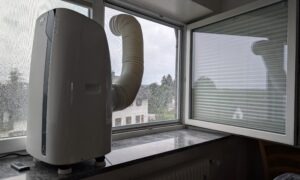
KlimafensterOur De’Longhi Pinguino PAC EX105 mobile air conditioner now blows hot air out through the exhaust hose without the possibility of sucking it right back in through that open window. Detach the hose and the window will still close like normal. Our bedroom is back to being a relaxing, cool place. Climate change has lost its edge, for now. Klimafenster from the outside

DIY Eco-friendly Drain Cleaner

The drain in our master bathroom shower/bathtub gets slow at times. Hair, soap, shampoo… it all slowly builds up inside to the point where it’s annoying. I used to buy this “Heldengrün Öko-Rohrreiniger” that I found years ago on Amazon. Less agressive to your drain pipes, and the environment, not life-threatening toxic, made with just a few simple ingredients – and still very efficient on “slow drains”. When I poured the last cup of it down our bathtub drain a few days ago,  I wanted to reorder on Amazon – but the product was marked as “not available”.

So I found the manufacturer’s website and searched for the product there. No luck. I then contacted the manufacturer through their contact form on the website, asking what happened to that wonderful drain cleaner. Customer service replied promptly, saying that they are not making this product anymore – even though it was very popular – because they wanted to focus more on cosmetics now. I responded asking (since they’re not selling the drain cleaner anymore) if they would be willing to share their recipe. They didn’t want to do that – but shared the widely known method of mixing sodium carbonate with white vinegar to (maybe) unclog drains. Uhm, no, I tried that.

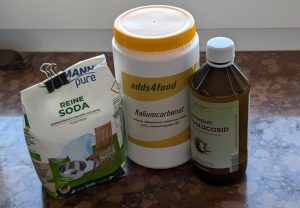
I really don’t give up so easily – and I still had the empty bottle of eco drain cleaner, with the ingredients listed on the label.ingredients list

Armed with that vague list of only three active ingredients I had a friendly conversation with ChatGPT. Impressive results came out of that after tweaking my prompt a little bit. The AI gave me an easy to follow recipe to make my own eco-friendly drain cleaner. I tested it on our bathtub drain right away – works like a charm! Exactly the same results that I achieved with the product from Heldengrün.


If you want to try for yourself, here it is:

  • Mix 1/2 cup sodium carbonate and 1/4 cup potassium carbonate in a bowl.
  • Add 2 tablespoons of coco glucoside or similar sugar-based surfactant to the dry mix.
  • Slowly add about 1/2 cup of hot water, stirring constantly to make a thick paste.
  • Pour the paste directly into the drain. If the stuff is too thick to pour, add just a bit more hot water until it slowly runs into the drain.
  • Follow up with 2 more cups of hot water.
  • Let that sit for an hour or more.
  • After that flush with generous amounts of hot water.

Bingo.

Just a little bit of caution, though. All the ingredients by themselves are non-toxic, food-grade, readily available to the general public. But when you mix them with water you get some pretty strong alkaline reaction. Wear rubber gloves to protect your hands and safety glasses to protect your eyes. If you accidentally get the product on your hands or in your eyes, wash with lots of running water immediately.

Blackout? Prepare for Wild Camping – You’ll be fine

The current energy crisis – if that is even a thing yet – has people worried about potential wide-spread, long-lasting black-outs. While I agree that the potential for these is real in Germany, especially as the winter comes up on us, I consider myself well prepared to survive at least two weeks without electricity.

Just think about what “no electricity” at home really means: it’s simply wild camping without the tent.

Unlike in the US or Canada, wild camping is generally prohibited everywhere in Germany – unless you do it on private ground with the owner’s permission. So, when your power goes out, enjoy your unexpected legal wild camping trip. Just make sure you have your supplies ready.

My list is sorted by priorities – the most important thing first:

  • bottled water, 3 litres per day per person
  • flashlights and batteries for those
  • portable toilet with baggies, gelling powder, and wet wipes
  • non-perishable food that doesn’t need refrigeration
  • essential medication (if you need to take any)
  • camping cooker or grill
  • disposable dishes and silver ware
  • sanitizer
  • cash
  • keep your car fuelled/charged
  • solar (or gasoline) powered inverter generator
  • charge your cell phone, if you can (but don’t expect to have a network available)
  • plenty of large, sealable plastic trash bags
  • if you have pets, consider their needs too

Some things are nice to have, like a way to heat your house with wood, or a filled rain barrel in the back yard. If you have to leave your house, make sure the pipes won’t freeze.
Also, don’t forget you’re not alone. There may be neighbours, or relatives, who are not as prepared as yourself. Help them!